Wow. Last night I watched the news and found out that local teen Amanda Todd committed suicide on Wednesday as a result of being repeatedly bullied, teased, made fun of, marginalized, dismissed, dehumanized, alienated, and surely much more. Her story speaks to me not only because I, like she, once felt completely alone and misunderstood (and stupid, ugly, and worthless, among other things), but also because it reveals the degree to which patriarchal attitudes are still around today. What I mean to say is that it's not necessarily just the individual 'bullies' that I blame (girl or boy) but rather it's the naturalized ideas about girls (as sex objects, for example) that the 'bullies' are conveying that I blame. And I go to bed at night and I wonder why the hell more people don't see a problem with these ideas. Don't speak up about them. Don't want to understand, aren't open to understanding, they're transparency, their historical and social construction, their falseness.
Catergories
Showing posts with label OPINIONS. Show all posts
October 12, 2012
RIP Amanda Todd.
Posted by
Caroline
Labels:
#RIPAmanda,
Amanda Todd,
bullying,
girlhood,
girls,
OPINIONS,
teen suicide
0
comments
October 8, 2012
Happy Thanksgiving.
Posted by
Caroline
Labels:
feminism,
feminist blog,
feminist bloggers,
OPINIONS,
thanksgiving
0
comments
September 26, 2012
Fat.
I don't know about you, but my body and I have been on a long journey. When I was an adolescent, I felt fat and ugly. I remember looking in the mirror at my 'fat' stomach and flat chest. I even remember asking a babysitter if I would ever have larger breasts and a flatter stomach, instead of the other way around. I was desperate yet hopeful. I was 10. Already I knew that my value came from my appearance. When I was 14, I read a book whose protagonist drank only a glass of orange juice for breakfast. I was determined to do the same - wasn't that 'normal', 'healthy'?
Posted by
Caroline
Labels:
appearance,
body image,
caroline rothstein,
feeling fat,
feminism,
gender,
Opinion,
OPINIONS,
resistance,
struggle
0
comments
August 31, 2012
Capitol Pride 2012.
My friend Emma (who was visiting from Calgary last weekend) and I watched Capitol Pride in Ottawa last Sunday. It was my first time going to a Pride Parade (surprisingly, actually!) but I loved it! I had so much fun. It was so empowering to see all the love that was around. People were uniting in both small and big groups. Happiness and music filled the air. Smiles were everywhere. Feet and arms were moving, embracing everyone. I'm so not used to seeing people unite in such a way (I can name on one hand the other time's I've experienced something similar: the Olympics, the Stanley Cup, natural disasters (?????), so seeing this ... wow, it just made me realize how amazing and important it is when groups of different people unite. In my opinion, it needs to happen more!
Posted by
Caroline
Labels:
alliance,
awareness raising,
Capitol Pride 2012,
empowering,
feminism,
LIFE,
OPINIONS,
Pride Parade,
uniting
0
comments
August 24, 2012
Make-up: Yay or Nay?
I recently bought a few new Estée Lauder make-up products. It's been since Christmas since I invested in some new make-up, and it felt so nice to treat myself (and I received the lipstick for free!). That being said, I also wondered if buying make-up is a treat for other women? I've known various women who don't enjoy purchasing and playing with make-up the same way I do, or who don't wear make-up at all. I can see why, to be honest--like fashion, it involves participating in consumerism and femininity--two things which, I imagine, a lot of women don't identify with. On top of that, a lot of it is also loaded with chemicals and toxins (one reason why a lot of the make-up I buy is all-natural). Do you use make-up, and if so why or why not? Do you think using make-up can be trivial and pointless or do you enjoy applying it, buying it, and collecting it--or both? Sometimes I feel torn, so I'd love to hear what others think. Happy Friday! xo Caroline
Posted by
Caroline
Labels:
applying,
buying,
consumerism,
critical thinking,
Estée Lauder,
feminism,
HAIRMAKEUP,
make-up,
OPINIONS,
using
0
comments
June 26, 2012
Lonely Island Group: Funny and Feminist?
I love the Lonely Island Group. (Though they've recently stopped making videos!) I'm really into this kind of humour ... what might we call it, anyway? Below are two of my favourite of their videos and why.
This video is especially interesting because it satirically comments on our capitalist-driven society and it's domination by, let's face it, white people! The ruling social group is far too often considered inevitable and natural--the normal way things are. I love that this video humorously challenges that idea. Calling them 'feminist', however, might be pushing it (in fact, I hate labelling anything 'feminist', but thought the alliteration worked well for the post's title). I mean, they don't really bring gender into the picture. But that's okay, this post is more about what their videos do do. They tell us, "hey, the rich white people that make all the decisions about money and law and government and healthcare and advertising and you and me and even fashion are not naturally decision-makers--they're constructed as such. And HEY what about all those people that are consequently excluded from and marginalized in society????"
Also, this video is f*ing hilarious! It comments on the whole 'adult' versus 'child' opposition, as well as the idea of, like, a non-conformist who doesn't participate in consumerist culture. I'm not sure if they're making fun of these things or challenging them or both. Either way, they're bringing to light things that are usually ignored and taken-for-granted. xo Caroline
Posted by
Caroline
Labels:
feminism,
feminist,
Lonely Island Group,
OPINIONS,
popular culture
0
comments
May 4, 2012
Girls.
Have any of you watched or heard about HBO's new show, Girls? I've become slightly obsessed. It's sort of like a modern Sex and the City (which seriously got my through my high school years) that focuses on women in their 20's, as opposed to women in their 30's and 40's. It's kind of a hipster take on some of the humiliations and triumphs that a group of young women who are living in NYC and who have just graduated university with liberal arts degrees experience. It's honest and sarcastically and HILARIOUSLY funny and it so resonates with my life and experiences. !!
That being said, there's been some very profound and appropriate critiques of the show, as seen here. Namely, it's been critiqued for the extent to which it lacks diversity and whitewashes NYC. When I went to NYC I was in awe of how many different social groups I encountered; it was incredible! Although Girls emphasizes the many (unfair) troubles that (white) women college graduates encounter, it also seems to unquestionably reinforce their power and privilege. I mean, the show does seem to be about and for one group of women only: those who are white, who have access to post-secondary education, who come from middle-class families, and who are primarily heterosexual. As a result, I think it might exclude other groups of women and promote white middle-class dominance. But what do you think? The season just started, so it's also hard to say what Girls has in store for us.
Nonetheless, I think what it does is great. I'm not meaning to dismiss the show but rather want to point out what it (perhaps inevitably) misses. It's still definitely worth watching and enjoying. So check out the trailer below and the first episode here.
April 26, 2012
Contemplating Fashion.
Yesterday I saw this post on The Daybook and was immediately inspired. Do you ever feeling like your "fashion-self" or your "personal style" is unfulfilling? I'm dying to admit, I kinda do! Don't get me wrong, I get so much excitement and happiness out of material consumption and fashioning myself according to what I've come to see as my "personal style". I love it. I love it so much that I wonder why I love it so much. Because in addition to becoming increasingly obsessed with it as of late (perhaps since starting up this blog last August), I've also become aware that it's a never-ending process. I buy and I buy and I create and I create and I perform what I've bought and created and it keeps going on. There is no end point where I've finally achieved my personal style. There is no sigh of relief and no break and no "ahh, I'll take a step back and relax now". I'm constantly working and stressing and wondering if my style is good enough, close enough to the fashion trends, if I have enough of what I "need" and "want" to keep up my personal style. Like many women, I've been socialized to desire and literally embody the fashion industry and its dependence on material consumption and capitalism. Look at the first photo. Girls are taught to consume from an early age. (Also, why are all the girls in the photo white and thin and conventionally good-looking?) But it can be tiring, and, as Sydney pointed out, it sometimes feels trivial and even narcissistic (as I've said here and here). There are is so much oppression in Canada and the U.S. (caused by the very systems that I utilize and enjoy!) and here I am obsessing over a Roots bag that I got on sale and I am so so so happy about it. I'm not trying to make us feel guilty for material consumption. I just wanted to express how this negotiation of fashion and personal style, at least for me, is ripe with complex feelings that are often very difficult to negotiate. Do you feel this way, too? What are your thoughts? xo Caroline
April 2, 2012
Femininity & Fashion
I've been reading this book for my Graduate Feminist Theory class and I wanted to share a little bit about how it's affected me. The below blurb uses my own experience to pose a question for the class to ponder. I thought I'd share it here because it's very relevant to what I share on my blog... it relates to my fashion-self, that is. Anyway, see for yourself what I mean:
Reading Angela McRobbie (2009) this week got me thinking about femininity, the fashion industry, and my place within it. I feel a variety of contradictory feelings when it comes to creating and imaging myself according to normative femininity and the rules of the fashion industry. For example, on the one hand it feels trivial and overly narcissistic to invest so much of my time and energy into fashion and imaging myself—and all in the name of a feminine appearance! Although some of these feelings might, I think, be influenced by the standards of normative femininity itself—that is, its expectation that women maintain a very particular degree of femininity: not too little yet not too much. On the other hand, I enjoy feminine adornment and the material consumption that the fashion industry promotes and is based upon. I’m creative; I like putting together outfits. I live in an individualistic society; I enjoy creating a fashion image and identity for myself. I’m materialistic (okay, I relunctantly admit it); but I grew up in a capitalist consumer culture!!
I realize, though, that maintaining femininity by means of fashion is a never-ending process, for “the achieving of femininity invariably fails in some respects” (105). I’ve also at times begun to see myself as an object to be manipulated, fetishized, contained, and monitored. I really do begin to wonder: “Is this me?” “Do I really exist?” (106). I become fragmented, so (self) involved in a fulfilling yet ultimately unfulfilling project that is relentless, that constantly signifies my own limitations, my own “fearful lack” (106), my threat as an unruly leaky body—as a woman. Maybe this is one reason why femininity and fashion are so crucial to my identity. I want to bring my sexual difference “to order” (107). But again, I also simultaneously enjoy the impossibility involved in creating my feminine subjectivity. And there’s got to be a certain degree of agency in this, right? I mean, although I have come to see myself as object, I’m still an embodied subject. Otherwise, I’ve dismissed myself just as the patriarchal gendered order has dismissed me. Indeed, I’ve mobilized my very subordination; I actually embody it. And I’m no cultural dupe; I see that my success is based upon my conformity to the norms of femininity. I also see that I can receive various degrees of power, pleasure, and privilege from maintaining my feminine subjectivity.
So my question is this: Is their agency in conformity? Can we reconcile these contradictory feelings and experiences; I mean, can we reconcile enjoying femininity and fashion, for example, and feeling frustrated by them? How? What do you think? xo Caroline
March 22, 2012
Target Women
Do you feel like laughing your ass off AND being critical of the media? Then you should most definitely take a few minutes and watch these videos. If you're like me, you'll immediately become addicted! Though these were made a couple of years back, they are still so relevant. They use satire to simultaneously laugh at, point out, and challenge very gendered, as well as heterosexist, racist, and classist ideas about what it means to be a woman and a girl in our contemporary Western (North American?) society. They also point out the degree to which the ideas embedded in much advertising, TV, movies, and other forms of popular culture are socially constructed. Here are three of my favourites:
God, I f*ing love Sarah Haskins. She may just be may new idol. I really have this overwhelming desire to share her brilliance with others... so let me know what you think! xo Caroline
December 22, 2011
Challenging Sexist Christmas Songs--And Enjoying them?
If you're like me and you practice Christmas, than you love this time of the year. You like Christmas traditions, especially their nostalgic aspects, Christmas decorating, spending time with family and friends, eating and making/baking homemade foods, appreciating others, giving to others, and, of course, getting from others.
But do you ever notice the creepy and sexist aspects of Christmas? I know, it's not something I want or necessarily like to think about either. But I think it's important to acknowledge. For instance, traditional Christmas songs, even new Christmas songs, are embedded with patriarchal ideas.
I recently watched this video over at Feminist Frequency:
As happy as I am that this video necessarily points out many of the deep-seated ideas about women and sexual violence that exist today, I'm also a little put off by it, and I'll tell you why. What about when you like and enjoy Christmas traditions and songs, even though they are incredibly sexist? This is a tough position. But before we can talk about how to reconcile such a position, if that's even possible, perhaps we first need to acknowledge and emphasize the normalized and oppressive ideas that are reinforced and promoted year after year at Christmas time. This is why I love Feminist Frequency's videos. At the same time, I wonder if it is possible to acknowledge--even challenge--such ideas while also participating in culture, albeit a patriarchal and racist one.
That's why it's important to actively engage in our lives and in society and culture as feminists--because we're needed and can do this! These songs (especially "Baby, It's Cold Outside", which is disgustingly creepy) indicate that we live in world that neither listens nor hears women. We live in world that does not consider women fully human beings, but rather condemns them as inferior, unimportant, pathological, and much much much much more. Feminists should not be defined according to popular myths about us--come on, those were socially constructed, and although they may have been or may be true, it's time to see beyond them. Let's actively participate in culture (we're not cultural dupes) by, for instance, performing our genders, AND challenging oppressive ideas.
3 f*ing days until Christmas!!
December 9, 2011
CBS's Unforgettable is...Unforgettable!
CBS's new fall show, Unforgettable, is just that: unforgettable. It's quickly become one of my favorite TV shows this year. When I sit down to watch TV, I like to be entertained. When I'm not watching sarcastic comedies like The Office, Parks and Recreation, and Up All Night, I want fast moving mystery or crime shows. (Although I've also recently become fascinated by AMC's The Walking Dead, a drama about zombies and a group of survivors trying to escape them). I loved Without A Trace, and hence I was automatically intrigued when I noticed that Poppy Montgomery (who was also in Without a Trace) was the lead in Unforgettable.
Despite my love of crime shows; I am always skeptical of them. Anita Sarkeesian over at Feminist Frequency sums it up pretty well:
"I usually can’t get over the glorification of the American Justice System. The cops and the prosecutors are usually depicted as 'good guys' who protect us from all the horrible, vile people in the world. This is such a conservative, skewed worldview that is perpetuated in the abundance of cop shows. These weekly crime shows also tend to have an extraordinary amount of violence against women, dead women, and evil murdering women as a way to maintain sensationalism."
This show most definitely reinforces a dualistic and limiting (and often a raced, classed, and gendered) worldview of "good" vs. "evil". Think about it: who's considered "good" and who's considered "evil"? At the same time, Unforgettable is an extremely powerful and positive show, especially because of Poppy, or, Carrie Wells. Carrie remembers everything, every detail about every day. Except for her sister's murder, which she painfully struggles to remember and "solve". As a police officer, her memory also helps her "solve" other murders.
Carrie's memory plays a prominent role in this show. Indeed, the plot is constructed around her memory. The show is subversive just in that it prioritizes a woman's memory, a form of knowledge that is not often considered "legitimate" in a world of "rational" men and positivist and post-positivist knowledge. Although Carrie's fascinating role may essentialize women; making white women's experiences stand in for ALL women's experiences, it also portrays Carrie in a complex, three-dimensional way. Poppy does not fall into, as Anita Sarkeesian states here, the "usual pit falls for 'strong women characters' by not playing the tough, badass, tortured, pessimistic, misanthropic woman."
All in all, there are problems with this show that are most definitely worth acknowledging. But that doesn't mean that it can't also be incredibly subversive, too. What do you think? Also, I want to note that there is NO good trailer for this show. Notice how it's her male "sidekick" that tells her she's good and that her memory is "legitimate"?
November 28, 2011
Good Ole' Stereotypes About Women --> ARE Sexist!
Recently came across this article on this blog thanks to a friend of mine. Was I ever impressed! I so appreciate that it's written by a man who cares about the current treatment of women in Western societies. Not many men speak up about these issues, let alone view them as issues at all. It's a bit of a read, so I'll sum it up. It basically talks about the extent to which women are dismissed as crazy, stupid, too sensitive, and irrational in a patriarchal attempt to emotionally manipulate them. The author calls this gaslighting and describes it like this:
"Those who engage in gaslighting create a reaction—whether it’s anger, frustration, sadness—in the person they are dealing with. Then, when that person reacts, the gaslighter makes them feel uncomfortable and insecure by behaving as if their feelings aren’t rational or normal."
So, gaslighting dismisses an individual's feelings and reactions as illegitimate in order to avoid taking responsibility for the her/his own actions. Although the author states that this may not occur to all women, which may be true, I've definitely seen a pattern of this occurring mostly to women, and often at the hands of men. At the same time, I know I do this, too. With that in mind, I understand and firmly believe that sometimes this happens; individuals fight, get angry, want revenge for hurt feelings. We are all human, so we should ALL take responsibility for our actions. It's when this is used as a way to FURTHER oppress and subordinate women that I draw the line. The author claims that this occurs most to women because:
"women bare the brunt of our neurosis. It is much easier for us to place our emotional burdens on the shoulders of our wives, our female friends, our girlfriends, our female employees, our female colleagues, than for us to impose them on the shoulders of men."
Furthermore, as a result of sexist and oppressive ideologies, "we have come to accept the idea that women are unbalanced, irrational individuals, especially in times of anger and frustration." So it's just easy to blame women, right?
Although I don't really like that this article victimizes women to the extent that he does (does it really render women "emotionally mute"????), I nonetheless believe it to be important because it calls attention to (and takes responsibility for!) naturalized and normalized sexism, sexism that is do discreet that it does not appear to be sexism at all. And, I'm so so SO sick of being dismissed in such a way. Aren't you?
*photo taken from this website
November 20, 2011
International Transgender Day of Remembrance
Today, Sunday November 20th, is the 13th annual International Transgender Day of Remembrance (TDOR). I think it is important to spread the word about this important day, which aims to remember those transgender people who have been been violently murdered as a result of their genders and sexualities. The gender and sexual identities of transgender and transexual people do not conform to society's expectations about gender and sexuality. They deviate from norms about masculinity, femininity, and heterosexuality. As a result, Jamie Ann Meyers, the author of this Huffington Post article, contends that transgender and transexual people are stigmatized, dehumanized, harassed, and discriminated against. They also experience intersecting forms of systemic oppression. AND they are subjected to brutal forms of violence.
According to Meyers, as well as this report by the National Coalition of Anti-Violence Programs, the United States experienced "27 reported hate murder victims of LGBT and HIV-affected people in 2010, representing a 23-percent increase over 2009. A disproportionate number (70 percent) were people of color, and nearly half of the victims (44 percent) were transgender women."
But not only do transgender and transexual people experience violence, they also do not have the same rights to protection as others have. As Meyers states, "often when legislation is proposed that would provide protection for transgender people at the federal level (e.g., an inclusive Employment Non-Discrimination Act) and in many state legislatures, we are turned away. "
I firmly believe that feelings of discomfort with those who are transgender and transexual are understandable. Indeed, we have internalized socially constructed ideas about who is normal and who is not. However, transphobia is unacceptable; no human being deserves to be treated in such away. No human being deserves to have their life taken from them because they had the courage to challenge societal norms. We need to acknowledge that transphobia is our problem--not theirs. We need to move past our discomfort, especially today, on International Transgender Day of Remembrance. Please, take today to think about those who died as a result of deep-seated transphobia, I know I will.
For more information, check out this website.
According to Meyers, as well as this report by the National Coalition of Anti-Violence Programs, the United States experienced "27 reported hate murder victims of LGBT and HIV-affected people in 2010, representing a 23-percent increase over 2009. A disproportionate number (70 percent) were people of color, and nearly half of the victims (44 percent) were transgender women."
But not only do transgender and transexual people experience violence, they also do not have the same rights to protection as others have. As Meyers states, "often when legislation is proposed that would provide protection for transgender people at the federal level (e.g., an inclusive Employment Non-Discrimination Act) and in many state legislatures, we are turned away. "
I firmly believe that feelings of discomfort with those who are transgender and transexual are understandable. Indeed, we have internalized socially constructed ideas about who is normal and who is not. However, transphobia is unacceptable; no human being deserves to be treated in such away. No human being deserves to have their life taken from them because they had the courage to challenge societal norms. We need to acknowledge that transphobia is our problem--not theirs. We need to move past our discomfort, especially today, on International Transgender Day of Remembrance. Please, take today to think about those who died as a result of deep-seated transphobia, I know I will.
For more information, check out this website.
November 13, 2011
Androgyny --> Sexy and Subversive?
Model Lea T
Model Maryna Buniak
Model Andrej Pejic
"Is this a brave new world of open androgyny we're exploring—thanks to Pejic, Lea T (despite her protestations) and others—as the fashion media has opined? Or are we merely fetishizing Pejic's gender ambiguous status and sticking with the same old gender logic that certain qualities and physical characteristics automatically put you in one of two categories—man or woman—and you must pick a side?"
I have to admit that I, too, am obsessed with androgyny. There is something so sexy and exciting about crossing normalized gender boundaries with appearance and self-image. Although this is how I interpret and experience androgyny, is this what the fashion industry aims to do? Personally, I don't think so. Just like using Blackface (which adds race into the picture), the fashion industry uses androgyny to reinforce a black and white dichotomy between male and female and masculine and feminine, all the while promoting consumer capitalism. They might challenge a few norms in the process, but I don't think that's the outcome. Rather than being taken seriously, transgender men and women and everything in between are fetishized and presented as veuristic spectacles so that fashion brands can make a statement and sell clothes. And, at the end of the day, the proper hierarchy between rich and poor, black and white, men and women, and masculine and feminine is reinstated and confirmed. Oh, and so is the ideal female body image--thin, light-skinned, and able-bodied.
But I still find androgyny sexy and subversive, in my own way.
November 8, 2011
Maggie Goes on A Diet: A Children's Book About "Health"??
Has anyone heard about this book? I'm not surprised that Maggie Goes on A Diet, a new children's book by Paul Kramer, has sparked so much controversy.
Yet Kramer's lack of knowledge about the reasons for and root of this controversy demonstrates that our society also lacks knowledge about ideas that appear to be natural and normal. Think about it: who defines what and who is healthy? And, as Katie points out, who defines who is "popular" and successful? These things are socially and culturally constructed by the power-laden ideologies and discourses that are embedded in our culture and society.
This book concerns me not just because it may promote body image issues and eating disorders, but also because it reinforces social and cultural ideas that are accepted as natural and normal. Healthy does not equal skinny and popular. And successful does not equal popular and skinny. But why do these ideas exist? And, furthermore, why are they still accepted as "truths"?
On another note, why is the focus of this book a girl, despite that it's written by a middle-aged man? I'll tell you why. Because girls are the ones that face the most amount of pressure to meet cultural ideals and norms. Girls are faced with a tremendous amount of pressure to "fit in", to be socially accepted, and to do this by being thin and "healthy".Yes, I know that men and boys are also met with these kinds of pressures, but they have an advantage--they are sexed as male in a world that values and hierarchicalizes men over women.
Although I feel sad for Paul Kramer who claims innocence, I also feel angry. He's still just another white guy who wants "his" women skinny.

P.s. Don't forget to LIKE me on Facebook!
November 6, 2011
Sunday Inspiration: Experiencing "Beauty"
The post showcases a water colour artist and photographer from Oklahoma who currently lives in Ireland, and who actually has her own blog (which is amazing! Visit it here). This artist, Erin, has posted these photos of herself taken by her husband after she gave birth to her daughter. He has accompanied these photos with this message: “you are beautiful, do you know that? and your imperfections make you even more perfect.” In a follow-up post, Erin responds:
i’m a mama…
my body is so imperfect and soft and sexy in a different way. in a real way… in a way that my husband grabs me and wants me. in a powerful way that- i carried life, i gave birth, and i nourish this babe. in a way that- i know i look more like you and less like airbrushed images. genuine and honest and imperfectly perfect.
being vulnerable can be powerful. loving yourself can be even more.
you don’t have to get naked and take pictures of yourself. you don’t have to be brave.
just start with compassion. for. yourself.
open your eyes wide and see the bigger picture. see beyond what stands in the mirror.
Although I have a problem with emphasizing that there is a "real" body and a "real" beauty, I LOVE that Erin points out the extent to which female beauty is constructed by our society and culture, especially according to a particular body type and physical appearance. For some reason beauty is constructed as coming from the outside only, void of feeling and emotion--an object that women can become if they try hard enough.
But Erin negotiates around the "beautiful" skinny female ideal, she resists it, challenges it. She insists that beauty is in the eye of the beholder, as the saying goes. But she implies that it is also felt, experienced, embodied. She feels proud of her postpartum body, she embodies her proud feelings. She experiences beauty in motherhood. Isn't that beautiful?
Are there not moments in our culture when we can at least momentarily push aside the pervasive ideas that define us, confine us? I think so. How will you resist them?
November 3, 2011
Our Bodies, Our Rights!
Peter, me, Dee, Amanda
Dee, Me, Janis
Dee
Amanda
Yesterday, a few people from the Saint Mary's Women's Centre gathered at the Victoria General Hospital on South Park Street in Halifax. We stood just down from the Pro-life protesters (whose campaign is to protest for 40 days in order to "save lives"). We had our own signs and pamphlets, which we were handing out to those who passed by. They included information about pro-choice and ways to reduce (not end) abortion, particularly for those who may not choose to have an abortion. We emphasized the importance of reproductive freedom--which women have, by the way, but which is also being diminished by the conservative party of Canada and groups life 40 Days for Life. So help! Spread the word about the importance of reproductive choice and living in a world that still doesn't support women's rights to or knowledge about their bodies.
Every Wednesday we've been out there (well, this was my first time) because the SMU Women's Centre is currently involved in a 41 Days of Truth campaign, which is a response to the international 40 Days for Life campaign. 40 Days for Life is a religious organization that seeks to end abortion. You can find out more about 40 Days for Life here. 41 Days of Truth was created by the two coordinators at the Women's Centre, Dee and Danielle. It aims to generate awareness about women's and girls' reproductive rights. You can find out more about this campaign on the SMU Women's Centre Facebook page, here. (And while you're there, why not "like" their page?) Each day, for 40 days (though we are well into the 40 days now), the SMU Women's Centre posts information about women's reproductive rights in an attempt not only to generate awareness about abortion and pro-choice, but to also create solidarity among feminists. YAY!
To find out more about women's reproductive rights and abortion rights, check out the Abortion Rights Coalition of Canada and Canadians for Choice. Also, check out Amplify Your Voice's 1 in 3 campaign, which posts videos about women's experiences with abortion, such as this one:
October 23, 2011
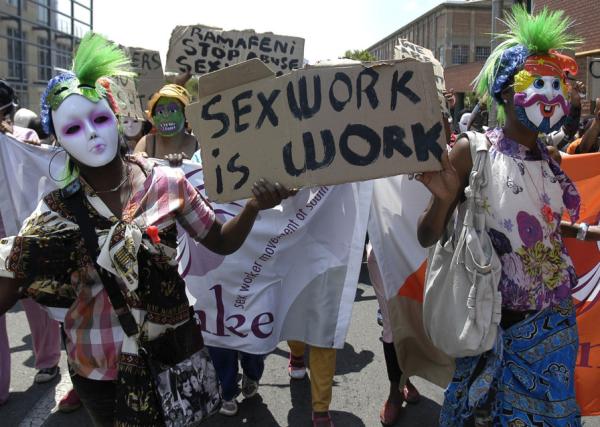
Sex Work IS Work and Sex Workers ARE People


Here are some current activisms on and about sex work and sex workers. After recently coming across an amazing blog called Tits and Sass, which is done by and about sex workers (!!!), I realized how important it is to hear sex workers' perspectives. Although I'm neither no expert on the topic of sex work, nor am I at all familiar with current laws surrounding sex work in Canada, I do know that sex work is currently unregulated in Canada and laws surrounding sex work vary from province to province. As Lizzy Hill from Halifax's The Coast says, "while selling sex is not illegal in itself, the Canadian Criminal Code prohibits the activities surrounding sex work." Because of the current legal and political status of sex work, there needs to be a perspective about sex workers from the point-of-view of sex workers.
As THIS article on Tits and Sass conveys, sex work and sex workers are often conceived of and understood in society based on negative stereotypes, many of which, according to the article's writer, aren't always true or fair. For example, the author contends that sex workers are often considered stupid and unable to consciously make smart decisions. Further, because they "sell" their bodies, they are also often considered separate from their bodies and thus not fully human. As such, they are dehumanized and objectified--that is, treated as objects and not fully competent human beings. Although this article may gloss over the patriarchal and capitalist ideologies that characterize "sex work", it does a great job and emphasizing the importance of sex workers and their voices and opinions.
Have a great Sunday!
As THIS article on Tits and Sass conveys, sex work and sex workers are often conceived of and understood in society based on negative stereotypes, many of which, according to the article's writer, aren't always true or fair. For example, the author contends that sex workers are often considered stupid and unable to consciously make smart decisions. Further, because they "sell" their bodies, they are also often considered separate from their bodies and thus not fully human. As such, they are dehumanized and objectified--that is, treated as objects and not fully competent human beings. Although this article may gloss over the patriarchal and capitalist ideologies that characterize "sex work", it does a great job and emphasizing the importance of sex workers and their voices and opinions.
Have a great Sunday!
October 17, 2011
Homophobia --> It's Still Around!

Just heard news of a 15-year old boy--son of a local Councillor--who committed suicide in the area where I live. He was openly gay and, as a result, was bullied throughout his childhood. Yet not only was he gay, he also did not "fit" with norms of masculinity. He liked figure skating, not hockey; Lady Gaga, not Blink 182 or Jay Z. Tell me, what the fuck kind of world do we live in that encourages exclusion, bullying, and discrimination, among other things, of those who challenge the status-quo, like Jamie did? And that STILL encourages and reinforces heteronormativity and homophobia? I don't know. But I do know that my heart goes out to Jamie Hubley, who was tired of living in such a world. I feel consumed with sadness for he and his family. RIP Jamie Hubley, RIP--you are so brave!
Check out the National Post's story here.
Subscribe to:
Comments (Atom)